Recent Writing
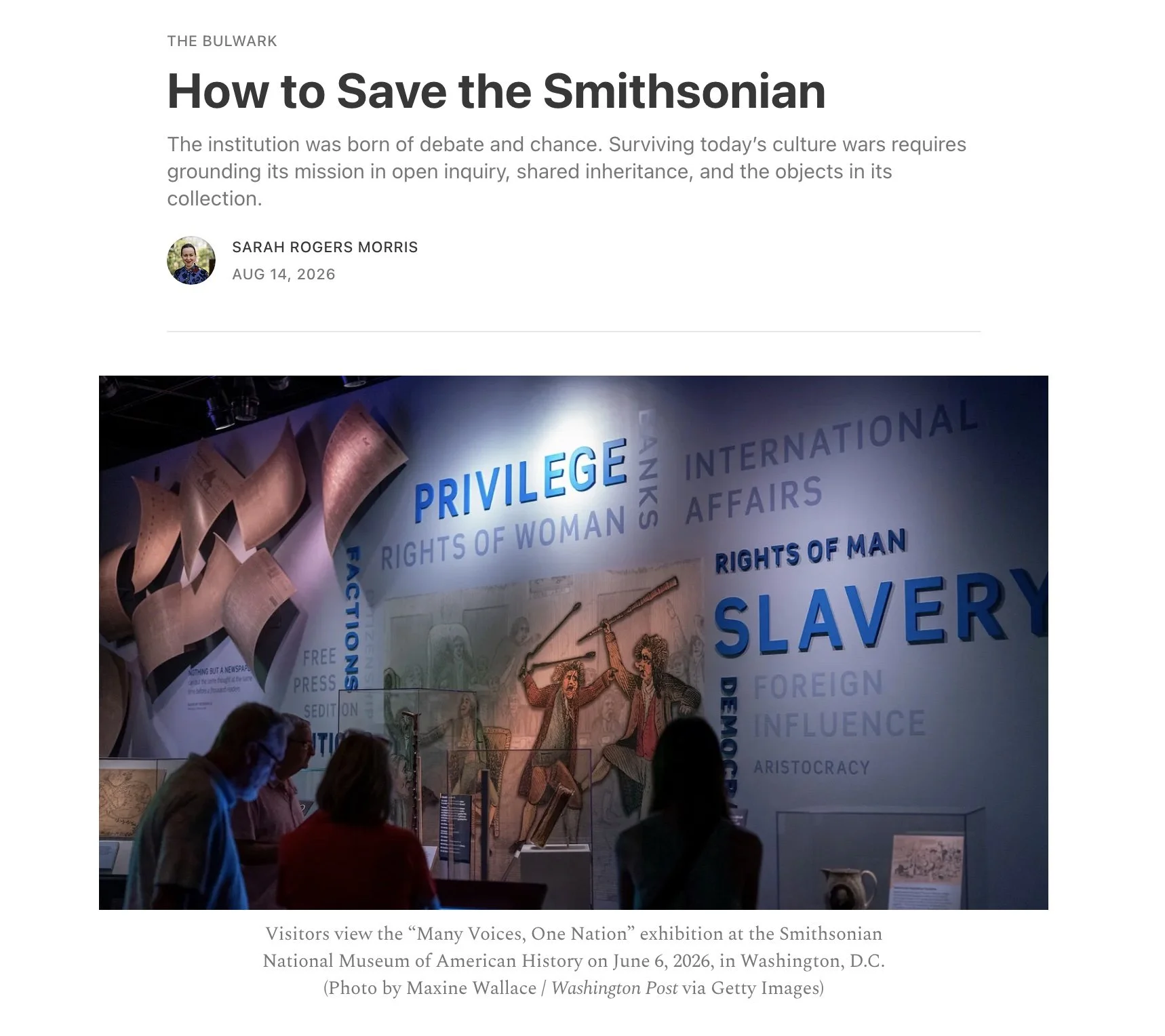
September, 11, 2026 - In my recently published article in The Bulwark, a pro-democracy platform for news and analysis on politics and popular culture, I propose a path through the current crisis at the Smithsonian, with lessons for museums everywhere.
This is a companion to last year's Chronicle of Higher Education piece, in which I argue for the civic value of teaching and studying art history.
The general thread here is that these institutions for looking at and thinking about art and objects are important to the health of our democracy.
Call for Entry
Common Things: Art and Objects in Public Life invites artists, designers, and architects working across media to reflect creatively on what thinker Hannah Arendt described as the "world of things," those durable features of the physical world that "relate and separate men at the same time." The show asks artists to consider what it means to share a world in common with others and how their work might be the basis for a shared world, bringing people together, setting them apart, and creating space for the difficult work of living together as humans who, by our very nature, think and act differently from one another.
The jury is especially interested in proposals that:
Create the conditions for shared making, looking, thinking, and/or conversation
Explore the crossing of political, cultural, and/or spatial boundaries
Draw on traditions of making that connect past, present, and future
Encourage us to see familiar images, objects, materials, and spaces in new ways
This exhibition is presented in partnership with the Hannah Arendt Center at Bard College and will be open at the AU Museum at the Katzen Arts Center in Washington, DC from February 6, 2027 through May 23, 2027.
Alongside work by a small number of invited artists, the exhibition will include works selected through an open call.
Criteria:
We welcome wall-mounted work in all media, including but not limited to painting, drawing, printmaking, photography, collage, mixed media, digital media, design, wall-mounted textiles and fiber, text-based works, and architecture-based works.
All submitted works must be wall-mounted or otherwise presented in a two-dimensional format; free-standing or fully three-dimensional works will not be considered.
Artists, architects, and designers at any stage in their career are encouraged to apply. Applicants must be based in, or the submitted work must originate from, the Mid-Atlantic region of the United States (Virginia, West Virginia, Maryland, Washington, DC, Delaware, Pennsylvania, New York, or New Jersey).
Individual works may not exceed 36 inches in any dimension or 35 pounds in weight.
Submitted work should engage—directly or indirectly—with Hannah Arendt’s ideas about the public realm and the “world of things,” as articulated in Chapter 2 of The Human Condition. Applicants do not need to illustrate Arendt’s writing literally; rather, the jury is interested in thoughtful, creative responses to these ideas as they relate to contemporary public life. For further context, applicants may wish to consult the following talks:
The Hannah Arendt Center Virtual Reading Group, The Human Condition 2021 Ep.#3 (The Public and Private Realm | First Part)
The Hannah Arendt Center Virtual Reading Group, The Human Condition 2021 Ep.#4 (The Public and Private Realm | Second Part)
Submission Details:
Artists are asked to submit the following through the link below by April 15, 2026 (11:59PM EDT):
Bio & CV
A brief, jargon-free artist statement (maximum 500 words) explaining your work and its relationship to the themes explored in the exhibition.
Up to 5 images or media files, each with a short description and tombstone information (including artist's name, year of completion, medium, dimensions (H x W x D), weight, and photo credit if applicable)
Hanging hardware requirements and installation instructions
Value of work (for internal logistics only)
The application period for this Call has now closed and we are no longer accepting submissions.
Jury:
Leili Adibfar, Art Historian, University of Illinois Chicago
Roger Berkowitz, Founder and Academic Director, Hannah Arendt Center at Bard College
Marisa Lerer, Art History, Florida International University
Jack Rasmussen, Director and Curator, American University Museum at the Katzen Arts Center
Sarah Rogers Morris, Director and Curator, Crowstep Projects
For questions about this project or the submission process, please reach out to exhibition curator Sarah Rogers Morris at director@crowstepprojects.com.
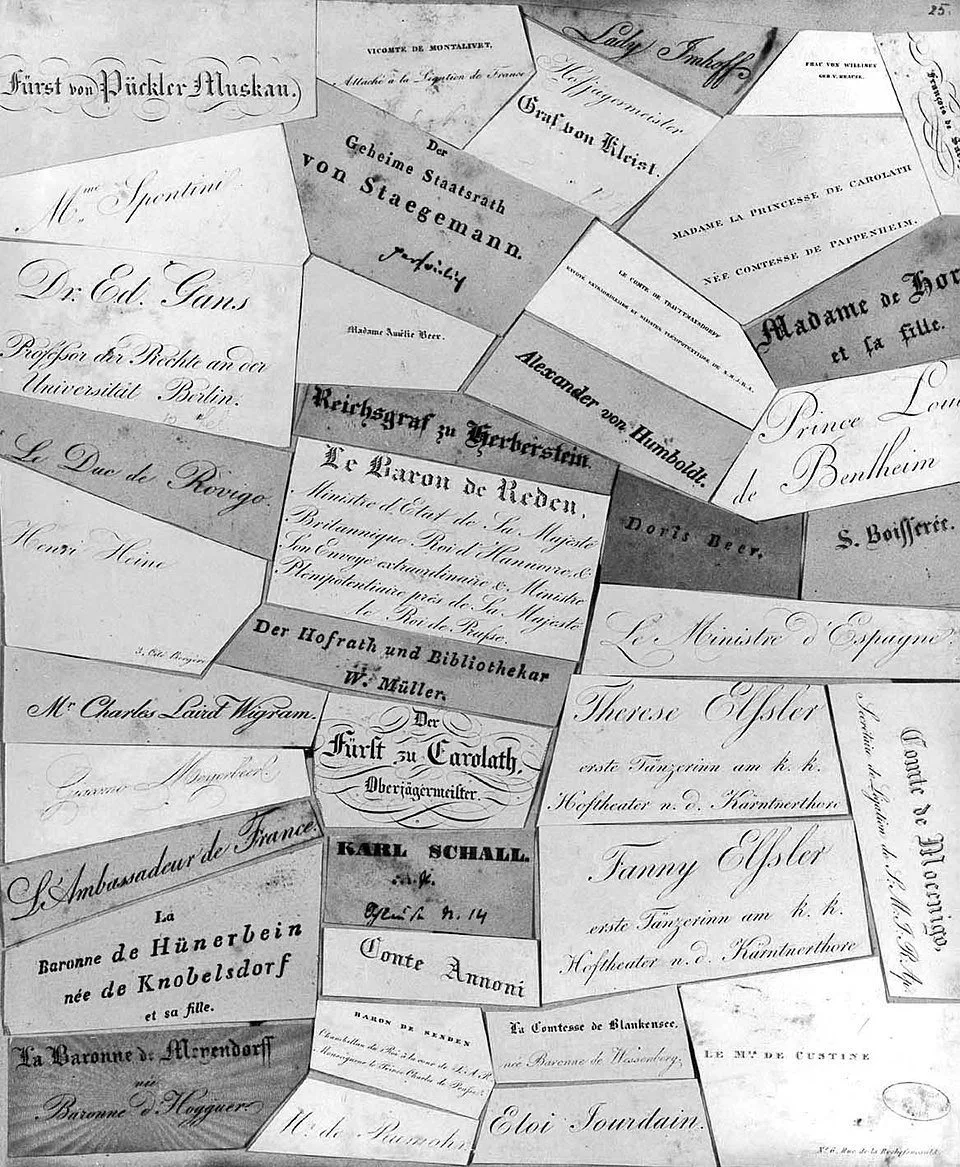
Image: 1830 collage of visiting cards from Rahel Varnhagen’s salon, reflecting a social world in which attendees adhering to differing worldviews participated in the open exchange of ideas. Varnhagen was a writer and intellectual known for her influential late eighteenth- and early nineteenth-century salons. She was also the subject of a biography by Hannah Arendt.
Source: Berlin State Library, Prussian Cultural Heritage

